







The Importance of Groundwater
Groundwater has always been a mystery since – by definition – it’s invisible. But that’s no reason to ignore it, because groundwater is critical to all of us regardless of whether we get our drinking water from wells or municipal water systems. There’s ten times more water stored as groundwater than is stored in rivers and lakes.
In wintertime the only source of water for surface flows (rivers and streams) is from groundwater inflow, which is why surface water levels in the Elbow River are generally lowest in winter. To add to the fragility of the water cycle, there’s little or no recharge in the aquifers throughout the winter months. These underground water reserves depend on whatever water build-ups have taken place prior to winter, and summer/fall build-ups or replenishments can vary dramatically from year to year.
To better understand these variations and their impact on our water supply, Rocky View County (RVC), in conjunction the University of Calgary (UofC), initiated a county-wide well-water monitoring program in 2007 under the direction of well-known hydrologist, Dr. Masaki Hyashi (https://gwfnet.net/rockyview). Several members of the Bragg Creek Environmental Coalition have participated in this program since its inception. It consists of lowering a specially designed measuring tape down a well with an electrode probe at the end. When the probe touches the water level, a signal is transmitted and the depth to the water table is recorded. This procedure is conducted, ideally, every 2 weeks. On some wells continuous monitors have been installed, which record water depths every hour. Some probes also measure water temperature. The graph below shows the type of data that’s been gathered over the years.
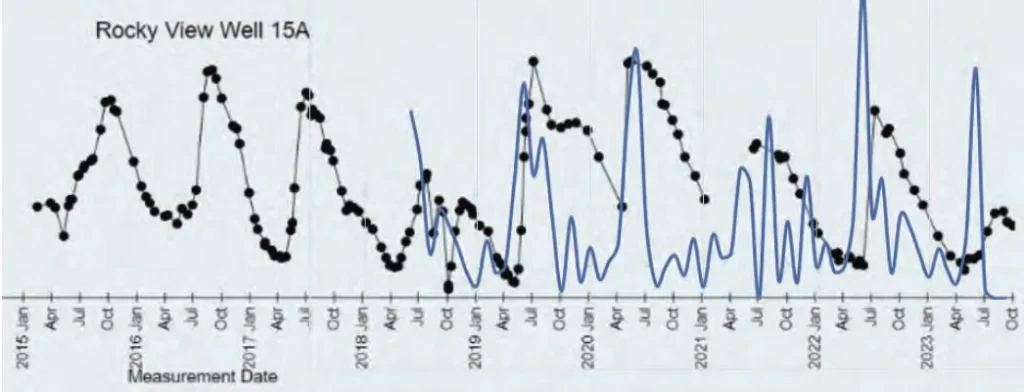
The black-dot curve is the depth to the water table in a well in West Bragg Creek. Superimposed on that, the blue curve is precipitation data from the Foothills No. 31 weather station. The correspondence between periods of maximum rainfall and the highest water table levels is not surprising. More surprising is that our maximum snow-melt in spring results in so little groundwater recharge. Water from melting snow contributes almost nothing to the aquifers and is dispersed only as surface runoff. Surface runoff is essential for filling rivers, ponds and dugouts but does little to fill or refill aquifers in spring.
Measuring groundwater levels year- round is essential to understand the sustainability of our potable groundwater resources. To this end, the groundwater committee of the Bow River Basin Council initiated a program in 2024, expanding the UofC – RVC water-well monitoring program into the other municipal jurisdictions situated within the Bow River Basin – including the M.D. of Bighorn, Foothills County, Banff National Park, Wheatland County, and Newall County. Anyone interested in participating in this expanded program should contact the BRBC at https://brbc.ab.ca/. Additional information on groundwater in our area can be found on the Elbow River Watershed Partnership website (https://www.erwp.org/) and on the provincial Ground Observation Well Network (https://www.alberta.ca/lookup/groundwater-observation-well-network.aspx).
The main takeaway from this is that, regardless of whether we live in an urban area or in the country, we should always be hoping for rain in the spring and summer to refill our aquifers – but as we found out in 2013, not too much rain.
Please check out the work we do at braggcreekenvironmentalcoaltion.ca, follow us on Instagram @braggcreekenvcoalition and email us at braggcreekenvcoalition@gmail.com
By Alan Breakey



 Please check out the work we do at braggcreekenvironmentalcoalition.ca, follow us on Instagram @braggcreekenvcoalition and email us at braggcreekenvcoalition@gmail.com








 Free Classifieds