









June has arrived with baseball season in full swing and a day to celebrate our fathers, so why not talk about a fantastic feathered father who weighs as much as a baseball and is about the size of a jay. It is the smallest member of the falcon family, the American Kestrel.
These “hummingbirds” of the raptor world use their light weight to their advantage as they fly into the wind and flap to hover in place as they search for prey in open areas. Their keen eyesight allows them to spot some of their favorite prey insects and small rodents as they dart in and out of cover. The kestrel can drop down and then hover again as they wait for the right moment to capture prey in their talons and swiftly finish it off with the falcon’s specialized beak. The beak has a key identifying feature, the tomial tooth, a sharp triangular-shaped notch on the outer edges of their top beak that they use to quickly kill their prey by severing their neck vertebrate.
In Alberta, June is when you will most likely be observing this hunting behaviour from a male who is feeding his family. The male kestrel finds several potential cavity nest sites between late April and mid May and the female chooses the one she likes best to lay her eggs. As she incubates the eggs for about a month he will hunt and provide food for her. Once the eggs hatch he still continues to provide most of the food for the nestlings until they leave the nest another month later as fledglings. An example of exemplary father behaviour.
Despite his smaller size he will defend his territory with his shrill “killy killy killy” call
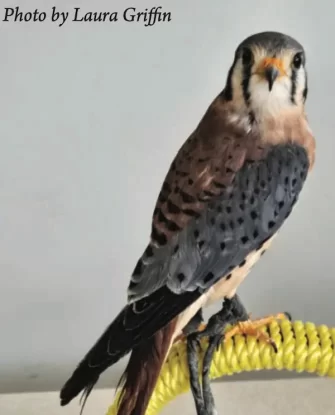
If you are looking to identify the American kestrel they have some fun features, like eye spots and a beak-like marking on the back of their rusty feathers to help them trick potential predators. The kestrels have two black moustaches called malar stripes which helps them with their diurnal hunting as it absorbs sunlight, kinda like having built in sunglasses. They have a light underbelly with black markings. Unlike other raptors, the kestrels display sexual dimorphism, which is a fancy way to say you can tell males and females apart by how they look. In addition to the rusty colouration males have greyish blue on their wings and as a headband.
I had the pleasure of working alongside Reggie the American Kestrel from the Alberta Birds of Prey Foundation at a recent work event. He is an educational ambassador that brings awareness to birds of prey and the dangers they face. If you are looking for a fun day trip for dad or any birder in your life to get up close and personal with birds of prey and help with the recovery efforts of Alberta’s first privately licensed raptor rescue and conservation organization then I suggest heading to the Alberta Birds of Prey Foundation website at https://burrowingowl.com/













 Free Classifieds