









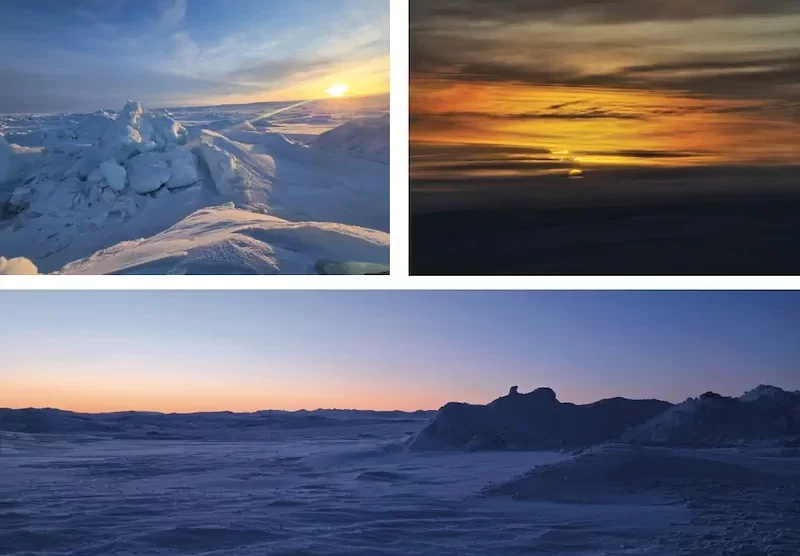
My love of the cold winter and darkness has drawn me to Alert, the northernmost continuously inhabited settlement on the planet.
There is a certain beauty in the vastness of tundra, the snow and ice stretching out for as far as the eye can see. The sun, barely breaching the horizon, casts shadows that stretch between the fields of crumbled sea ice in the distance as I gaze out, longingly searching for an Arctic creature, knowing full well that their camouflage would not reveal them to my probing eyes unless they moved. But merely a few weeks ago the horizon was nothing but darkness and stars shone throughout the day.
The winter world was waiting for the sun that had not been seen in its entirety since the end of September. It felt like a landscape of anticipation. As the earth travels in its orbit around the sun it is tilted at a 23.5 degree angle. This leaves the northern hemisphere pointing away from the sun, and if you are at a latitude of 82°30’05” north this means you are pointing away from the sun in total darkness for the whole winter. You can get the sunlight that reflects off of the moon’s surface, but other than that the world goes dark, many of the animals migrate further south, and the tiny plants that manage to live here are buried beneath the snow. For days the people on the station (some who had endured months of darkness) looked out on days of beautiful twilight until finally the sun crested the hills. There was a sunrise ceremony to welcome back the glowing orb which makes any life possible at all up here.
The arctic is a place of scarcity. Despite being surrounded by ice and snow, it is classified as a desert with less than 16 cm of precipitation in the year at Alert, that’s about half a ruler for perspective. The land of the midnight sun receives just as much daylight as elsewhere on the planet, albeit at different times of year. But the sun is so low on the horizon that the rays of sunshine hitting the ground do so at a smaller angle spreading out the radiation making it harder to warm the ground. The rays also spend a longer time traveling through the thick atmosphere which in turn absorbs more of their energy before it even reaches the ground. This is part of the reason why the Arctic is known for being so cold. There is nothing quite like a minus 40 day with winds gusting over unbroken tundra to make you appreciate your parka’s oversized hood.
I look forward to April 7 when I will see my first midnight sun, as it will no longer
set behind the northern horizon. The tracks, which are becoming more plentiful with each passing day, indicate the animals are starting to reappear and perhaps soon I will have more than a fleeting encounter with my new arctic neighbours. The silent Arctic darkness is receding and with it my ability to contain my excitement for an Arctic Spring.
Photo by Laura Griffin












 Free Classifieds