









November may be an unusual time to be thinking about fish, but nonetheless November 21st is International Fisheries day. To dive into the festivities, why not consider the life of these scaley neighbours when the world they live in becomes, at least on the surface, rather ice cold and inhospitable. What steps must a fish take to survive winter?
Water is a wonderfully unique substance in that unlike most liquids it becomes less dense when it freezes and expands. Water is at its densest at 4°C, as it drops below this temperature the more cold but less dense water floats to the top. Thus, why ice cubes float on liquid water and, more importantly for the fish, water freezes from the surface first down to the bottom. This ice layer also helps to insulate the water underneath from the winter weather above. Step one for fish, find deep enough water that it remains liquid, and they don’t become a fishcicle.
The ice might be saving the fish from the cold winter winds above, but it also brings a new problem. Without the interaction between the air up above and the water underneath the ice, there is no oxygen being exchanged. Aquatic plants aren’t getting as much sunlight from up above, so their photosynthesis slows down, which is another way to oxygenate the water in the warmer months. The waters’ oxygen levels drop in winter. In addition, food is scarcer as there is only what was trapped underneath the ice when it froze. Step two for survival, the fish must slow down their metabolism to use less resources.
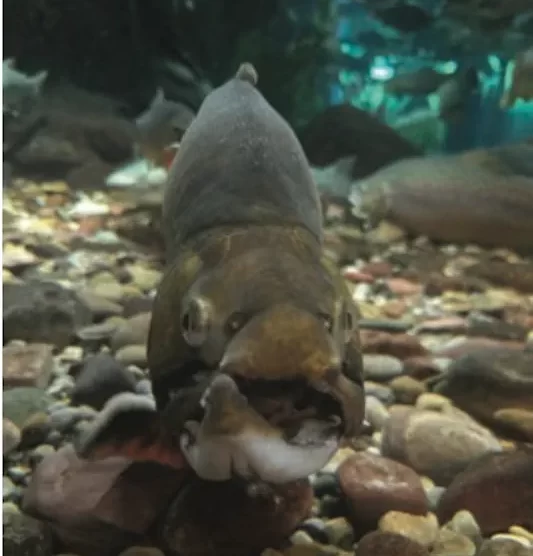
Luckily fish, unlike humans, are cold- blooded or ectothermic creatures; they do not use the food they eat to generate heat. Fish can enter into a state similar to hibernation where they slow their breathing and metabolism to almost nothing, and their heart rate drops. If you were to cut a hole in the ice and stick a camera down into the water you would find that in the deepest parts of the water, where it is warmest, several fish would be gathered in a cluster; they would just be floating not really moving about at all. Essentially chilling with other finned friends in their near freezing waters trying to conserve every calorie that they can and breathing as little as possible. Even with this strategy, some water bodies will fully run out of oxygen in which case all of the fish in it will meet a tragic end.
The next time you are skiing over a frozen river or skating across a frozen lake this winter take a moment to consider the unseen world below. Think warm thoughts for the fish huddled together in the deepest and warmest water they can find, practically holding their breath and waiting for the warmth of a spring day to melt the ice and return them to their regularly scheduled activities. Perhaps with a little reflection we too can find things in our busy winter lives that we can chill out about.













 Free Classifieds
