









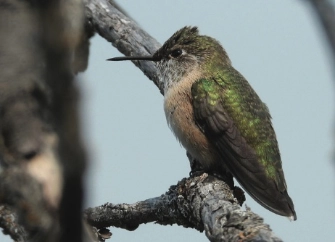
As summer draws to a close, the daylight hours slowly dwindle into increasing twilight and darkness, telling me that one of nature’s most incredible feats is about to begin. The young birds that have made it from egg to nestling to fledging have come to what might be their greatest test of strength as a juvenile, the fall migration.
Around 70% of the birds that nest in North America are migratory, traveling hundreds or thousands of kilometers across the globe to make it to their winter grounds. The calliope hummingbird — with a wing span of just over 10 centimeters and weighing somewhere between the weight of a penny and a nickel — is thought to be the world’s smallest bird migrant and will migrate over 4000 kilometers this fall. The juvenile birds are doing this journey for the first time.
In order to do this task, they must pack on as much fat as possible into their tiny bodies, a trick indeed when one still has to overcome gravity. Some bird species have even been known to reduce the size of their internal organs in order to make space for extra fat stores.
On this journey they will be up against many perils. From habitat loss in stopover sites, to ingesting pesticides as they move over agricultural spaces, to unfamiliar predator species, the migrating birds run the gauntlet. In addition, 80% of our migrants do so at night where light pollution adds the threat of window strikes, building collisions and the loss of view of the stars from sky glow that some species rely on to navigate safely to their overwintering sites. Bird mortality rates are highest for birds during fall migration and some estimates state only half will return the following spring.
But why migrate at all if it is so dangerous? Why can’t the birds just stay where it is warm all year? There are a few reasons. One, is to move to an area with more food and less competition. Another reason is better breeding grounds, with fewer predators and safer nesting sites available. The northern latitudes also have longer daylight hours in the summer giving parents more opportunity to forage for their young, increasing their chance of survival. There simply would not be enough resources to support the biodiversity of birds we have currently on the planet if they were all competing in the tropics all year long. Our summers would be far more dull and our ecosystems much more strained.
If you would like to help the migrating birds with this arduous journey, there are simple steps you can take:
1. Turn off your lights from 11pm to 6am between now and November for nocturnal migrants
2. Give the birds a respectful viewing distance to help them save their energy reserves.
3. Plant native plants in your yard so the migrating birds can bulk up with the proper nutrition.
4. Provide safe and shallow water drinking sites.
5. Prevent fatal collisions by using an effective method to treat your glass railings and windows
6. If you live in town, keep your cat indoors
Get more tricks and information at Bird Friendly Calgary www.birdfriendlycalgary.ca/














 Free Classifieds