









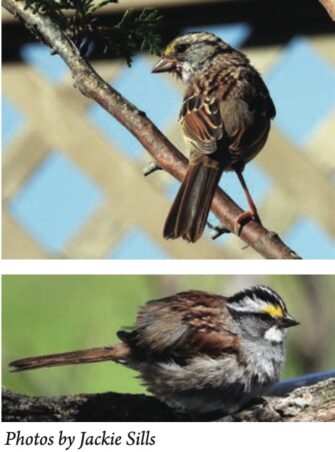
It seems that lately you cannot walk into an establishment without having the FIFA fever thrown in your face. Timbits have changed flavours, grocery stores have themed soccer sections and pubs are blasting out chants and futbol games. With 48 nations participating and three host countries it is not hard to find a nation to root for. Wandering through the woods to escape the soccer frenzy you might find yourself wondering at a very distinct sound emanating from the wilds, “Oh sweet Canada, Canada, Canada”. Don’t worry a soccer hooligan has not followed your tracks; you are listening to the very patriotic call of the small but mighty white throated sparrows returned from their winter territories.
I like to think the white throated sparrows are rather accommodating to birders compared to other sparrows. They have a lovely white throat, as the name implies, a white stripe on the top of their head, and very distinct yellow marks between the eyes and beak called lores. At almost 17 cm they are also a larger species of sparrow. The only tricky thing about identifying these sparrows is that they come in two morphs: one with bright white facial markings, the other with more tan facial marks. They are the same species however, and if you are lucky enough to spy a breeding pair, you might notice that opposites have attracted one another. Not because the colours are tied to gender, but rather because of behaviour. The white stripes are more bold and territorial while the tan stripes are more calm and focused on parental care. This “negative assortative mating”, as science calls it ensures that the young get the benefits of both behaviours from their parents.
Speaking of young, the white throated sparrow is one of several ground nesting birds. They prefer to build their nest on or very near to the ground with a little vegetation covering it making it only visible from one side in forested areas near clearings. The eggs are incubated for just over a week and the nestlings hatch featherless and helpless, taking up to 2 weeks to fledge. This means that if you hear and see White throated sparrows(or any birds) near your soccer fields or dog parks you should be cautious about keeping the ball play away from the wooded edge and keeping the dog on a leash because often dogs can find and consume the young in a ground nest without the owners even being aware of the little snack break. If you hear the sparrow calling, “pink”, this is an alarm call. It maybe a parent trying to warn you away from the nest.
May you enjoy your soccer frenzy this spring, but in the spirit of cooperation, let us be mindful that our recreation areas can sometimes become nesting sites for our wild friends. Scans of the fields before we begin for ground nests and camouflaged fur babies like hares and deer can help both us and the birds continue our chants of, “Oh sweet Canada, Canada, Canada”.













 Free Classifieds