






WHEN ROADS AND WILDLIFE COLLIDE
Sometimes, life gets in the way. Literally. Every year, thousands of animals lose their lives on Alberta roads. Sadly, the Bragg Creek region happens to be a province hot spot. According to the Alberta Wildlife Watch Program, (https://www.alberta.ca/animal-vehicle-collision-safety-program) an average of 91 animals lost their lives on our local provincial and federal roads in the last 2 years; a number that only accounts for wildlife removed by highway maintenance crews. The remainder of roadway kills go unreported. Carcasses that are unaccounted for are typically eaten by other wildlife (i.e. crows, coyotes) whereas injured hit-and-run animals may run off into the woods, where they often succumb and die.
High-Risk Zones: Rural County Roads
The vast majority of wildlife-vehicle collisions occur on two-lane roads outside of urban areas. According to a human/wildlife safety study undertaken on Alberta Hwy 22 by the Miistakis Institute, (www.rockies.ca/files/reports/CorrectionFactor_Graphics_FULL_JAN2021.png) the actual number of wildlife-vehicle collisions is 2.8 times higher than in the official provincial statistical data. For the Bragg Creek region, that means an estimated 255 animals die each year from wildlife-vehicle collisions.
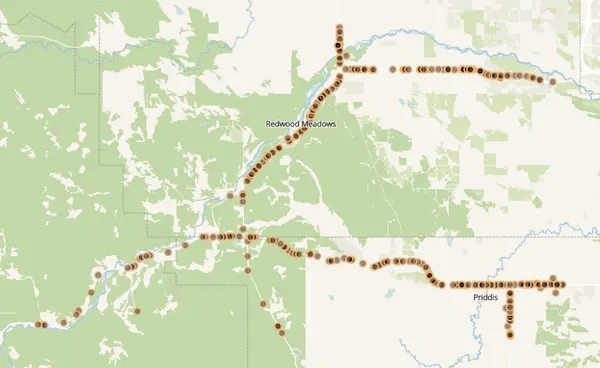
Wildlife-Vehicle Collisions In the Bragg Creek area – 2020 to 2024 – Each dot represents one fatality
As maintenance of county roads is the responsibility of the individual municipalities and local governments do not have a systematic approach to collecting data, no reliable data is available for local rural roads – roads that are high- risk zones, for these reasons:
Habitat Fragmentation – Rural roads cut through natural wildlife habitats, forcing animals to cross in search of food, water and mates.
Roadside Attractants – Salt runoff, vegetation and natural foraging movement draws animals to roadsides.
Driving Conditions – Long, straight stretches of rural roads encourage higher driving speeds; a behavior that can reduce reaction times in animal collision scenarios and increase impact severity on affected wildlife.
Seasonal Behaviors – The Fall rutting period and Spring migration brings more wildlife movement, increasing contact with vehicle traffic.
Animal Groups – Deer and other herd animals travel in groups and may cross roadways in sporadic ways and in unpredictable numbers.
Dawn and Dusk Visibility – Animal activity is at its highest during these two low-visibility periods.
How Alberta Transportation Tracks Wildlife-Vehicle Collisions
Alberta Transportation is using the Alberta Wildlife Watch app to enable authorized personnel, such as Highway Maintenance Contractors to report wildlife carcasses along Alberta’s highways. The data gathered will indicate where mitigation measures are needed for reducing animal-vehicle collisions, improving driver safety and reducing the impacts of highways on wildlife.
Roadway Species Mortality: Who’s Getting Hit?
Only large mammals are recorded in provincial statistics – bears, deer, elk, moose, horses, cows and other livestock
– and from time to time, cats, dogs, foxes, coyotes, hawks, eagles, ducks, geese and swans. Although anecdotal evidence indicates cougars and great grey owls are amongst the victims in the Bragg Creek area, such occurrences were not included in provincial statistics, likely because these collisions occurred on our county roads. Smaller animals including squirrels, mice and small birds are also not recorded.
Why It Matters: The Big Picture – Humans, Habitat, Biodiversity and Conservation Human Welfare, Economics
Mitigating wildlife-vehicle collisions (WVCs) is crucial to public safety. Such accidents cause human trauma, injuries and fatalities. Along with lost productivity, vehicular damage results in millions of dollars in annual insurance claim costs.
Habitat Connectivity
Existing roads create barriers to wildlife movement, isolating populations – causing loss of gene flow and leading to detrimental genetic and ecological consequences.
Biodiversity & Conservation
While wildlife mortality is a major concern on existing roadways, expansion of road networks is also reshaping animal movement patterns. Threatened and endangered species are amongst the animals suffering significant population declines due to increasing vehicle-related road accidents. This has a knock-on effect of disruption and degradation to overall ecosystem health.
Saving Wildlife, Protecting Drivers
Key strategies to increasing road safety include: lowering speeds (especially at dawn and dusk); installing engineered crossing structures; improving signage and awareness (yellow wildlife warning signs, seasonal alerts); implementing infrastructure solutions (wildlife fencing, overpasses and underpasses); exploring new ideas (animal detection systems); habitat management (vegetation clearing for road visibility and deterring wildlife)
SAFE DRIVING: BEHAVIOUR AND PREVENTION
- Speed reduction – observe local limits and locations with posted animal crossing signs
- Defensive driving – actively scan the r oad and ditches and look for glowing eyes at night
- Don’t swerve – avoid losing control and hitting other vehicles or the ditch
- Use strategic reaction – if hitting a large animal is inevitable, aim for its flank or hindquarters to minimize harm
By combining better data, local knowledge and smarter road habits, inhabitants and visitors alike will have increased awareness of local wildlife behaviours to respond safely on the ever-changing roadwayswe share.
For important links to additional information from provincial and scientific sources, visit www.braggcreekwild.ca. Become a member! It’s free!
Data Sources:
Alberta Wildlife Watch Program Reference
https://www.alberta.ca/alberta-wildlife-watch-program
https://www.alberta.ca/animal-vehicle-collision-safety-program








 Free Classifieds