






I have had the privilege to spend my entire career working at one grassland or another for years in this beautiful province. I have shamelessly promoted grasslands and their benefits to the natural world; I have lived alongside the extirpated swift fox, chased the endangered Kangaroo rat down for research and witnessed the endangered burrowing owl hunting on the great plains. Alberta Wilderness Association states that 75% of Alberta’s threatened species are found in grasslands. This love of grasslands was first cultivated during my childhood walks in Fish Creek Provincial Park where my parents would let us watch the controlled burns at a distance; these were to mimic the traditional prairie fires that rejuvenated the plains for generations.
My knowledge of grasslands’ importance grew tremendously when I started work at the Ann & Sandy Cross Conservation Area(ASCCA). Here I was able to work amongst Rough Fescue (Alberta’s provincial grass) and promote its importance to school children. I was able to witness the biodiversity that the tiny pockets of remaining native grasses (about 8%) on the land provided versus the large pieces of broken pasture land. Most importantly, I was inspired by the story of Sandy Cross and his wife Ann, and how important it was to him that his ranch was donated to the people of Alberta under the conditions that his three guiding principles were met. He had these guiding principles put on a brass plaque listed in order of priority and importance and had them hung outside of the education centre, Belvedere House:
1. To protect habitat and provide space for native species of wildlife.
2. To offer conservation education programs, particularly for young people, without jeopardizing area wildlife and habitat
3. Managing human use of the area through entry by appointment only.
“That expresses my wishes better than any other thing,” Sandy Cross once stated while pointing to the plaque (Paradise Preserved, 2002, Bruce Masterman). For years I shared this with countless school children watching them fall under the same spell I did from being on this beautiful landscape and hearing the story of Sandy Cross’ legacy. I always hoped my work would help them keep his vision alive to continue to conserve this land when the 99-year lease was up.
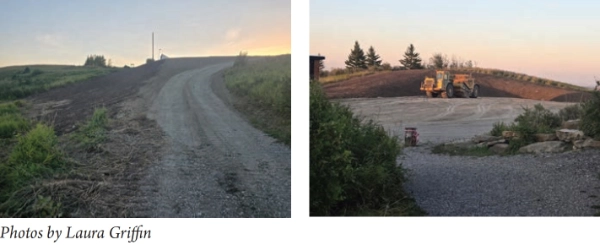
Perhaps I was too naïve. Words cannot describe the emotions I felt when I arrived on the ASCCA this summer to see the hillside with a patch of native grass beside Belvedere House had been plowed under. I felt the horror of having Joni Mitchell’s “they paved paradise to put up a parking lot” playing on repeat in my head as I contemplated how, on the hillside just northeast of Belvedere House, they held a ceremony on September 24, 1996 for Sandy to donate an additional 2800 acres to his first 2000 acres after deciding that people were following his wishes. What would this legend of an Albertan think if he could see this new development? Perhaps the new parking lot was seen as an important step to improve visitor access to the area; however, would this have been how he would have facilitated that change given his legacy and expressed heart. Have we sacrificed convenience over what the founders were trying to preserve?
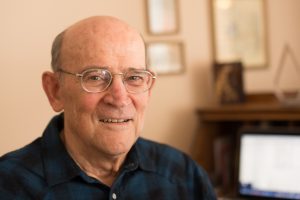
Sadly, both Sandy Cross and Ann have passed on and so we cannot ask them directly for their thoughts on this matter. Nor can we ask how he might feel about the fact that his guiding principles have been removed from the wall outside of Belvedere House. All I can do is read the words from his speech in 1996 with remorse, “I hope the guiding principles are still in effect here 100 years from now and 1,000 years from now.” (Rancher stymies urban sprawl. (1996). Daily Commercial News and Construction Record, 69(191), B1,B2.)












 Free Classifieds