







NSWO Nest-Box Program by Emma Barry
Last month we reported on the new Northern Saw-whet Owl Banding Station in Bragg Creek, and we’re thrilled to report that our first banding season was a huge success! BCEC not only supported important scientific avian research undertaken by the Calgary Bird Banding Society (CBBS), but also forged new friendships and alliances.
Ornithologist and Bander in Charge at the NSWO Station, Ethan Denton, invited us to collaborate with the Calgary Area Nest-Box Monitors Society (CANMS) to further NSWO research in Alberta. CANMS is a network of over 5,000 nest- boxes and nearly 100 monitors, working to provide habitat for native, cavity- nesting birds and collect valuable data for conservation efforts.
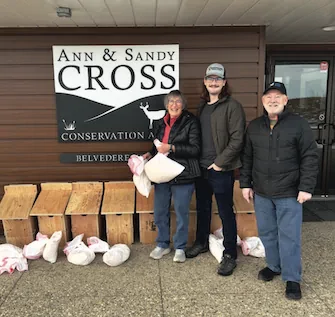
On January 10, we welcomed 45 guests to Ann & Sandy Cross Conservation Area’s Belvedere House for an afternoon of education and envisioning. Bob Cooper, VP of CANMS, delivered an overview of their work, followed by Ethan’s keynote address, covering the latest science on NSWOs, their nesting habits, and preliminary results from the Bragg Creek station’s inaugural season.
“Ethan Denton’s presentation gave participants an intriguing look into the life of this tiny owl and the work of the Calgary Bird Banding Society’s station in Bragg Creek. One key outcome will be the installation of nest-boxes for NSWO at selected sites throughout the area.” (Bob Cooper)
Bob designed and built 20 NSWO nest-boxes. Our members bought 17, which will be mounted on their Bragg Creek properties. Site selection and nest-box mounting will be undertaken by our team of experts with the benefit of property owners’ local knowledge to ensure optimum possibilities of attracting NSWOs. NSWOs normally nest in cavities excavated by large woodpeckers like Northern Flickers and Pileated Woodpeckers but will also readily use appropriate nest-boxes. Ethan explained that some squatters may also use the boxes: for example, Northern Flying Squirrels are particularly fond of boxes this size.
NSWOs prefer nesting about 12 feet up in mature aspen or poplar trees. They’ll choose a tree close to both mature coniferous trees, where the males like to roost, and to a water source. The female does all the work of brooding and incubation, remaining in the nest-box, while the male keeps busy hunting to provide food. When the youngest nestling is about 18 days old, the mother leaves the nest to the young and roosts elsewhere.
Those boxes that attract NSWOs will be monitored carefully by individual property owners. Data collected will include date of first sighting of the season, date of first egg, number of eggs, number of young, hatching dates, number of fledged birds, fledging dates. When the timing is right, our experts, with the property owners in a volunteer capacity, will band the young owls.
We’re excited about our next community event co-hosted with ERWP (Elbow River Watershed Partnership). ‘Fins & Feathers’ will feature two presentations by a fish biologist and a bird biologist, and a Q&A session. We’re planning a lively evening of food, community, and education, to promote protecting and preserving our natural assets. See you February 25, Bragg Creek Community Centre, 6-9 pm. Click on this link for more info and to register. https://fins-and-feathers.eventbrite.ca








 Free Classifieds