









I was enjoying the warm chinook weather one fine winter day when my eyes caught sight of the bright red warning colours of a ladybug creeping along the road. The red and black spots which serve as a warning to repel predators is called aposematic colouration. I paused to move the little neighbour into the sunny grass as this burst of movement brought on by double digit warm weather would not last and I thought my friend might not want to be trod on either. It might have thought I was a predator as I picked it up between my beaklike fingers and I am sure if ladybugs told tales this one would share its epic escape from my clutches. And I know exactly where it would share its tale.
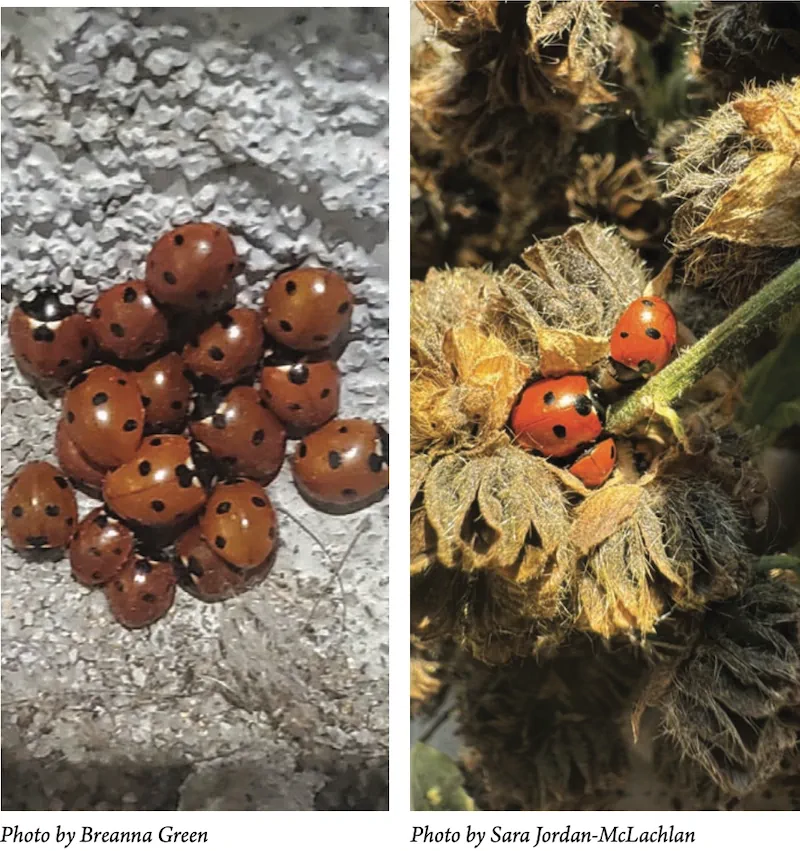
Ladybugs or ladybeetles if you want to be more accurate as they are in the Coleoptera (beetle) order, are not supposed to be awake in winter. They gather in groups called aggregations to withstand the cold of winter sending out chemical signals called pheromones to attract other ladybugs to where they think is a safe place to survive the winter. Sometimes these clusters can be found within leaf litter, or in bark crevices, or on the sides of buildings; I even found some clustered in cow patties before. These aggregations were thought to be useful because by cuddling up together the ladybeetles can control moisture better and get heat from one another making their own microclimate.
Another thought to the benefit of gathering together is to make the ladybugs less vulnerable to predators when they are in diapause. Diapause is the insect form of hibernation, a state where your metabolism reduces, the processes in your body can slow down or stop and you try to conserve as much energy as possible. This means no movement for up to 9 months. And no movement for something as small as a ladybeetle means they could easily become a predator’s snack. One hypothesis is that by gathering together the ladybeetles turn their small individual aposematic warning into a giant warning sign for predators to keep away.
However, research has also proven that there is a third reason why ladybeetles find snuggle buddies in the winter. They are looking for love. Groups are formed from both male and female ladybeetles and come springtime after spending that many months surviving the cold wind, snow and hazards of winter together they might very well have come to appreciate which ladybeetle might make the best parent of their future offspring. One of them may even have recounted a harrowing tale of when they woke up from diapause mid-winter, walked away from their cluster only to very narrowly escape being eaten by the ugliest bird they had ever seen with a weird squishy beak. If ladybeetles do share tales in their little aggregations perhaps my little friend is using our encounter to score some points on the dating scene. Perhaps not. What is certain is that come spring the females will fly away from the aggregations ready to go find a leaf to lay some eggs and start a new generation of these delightful red and black beauties.














 Free Classifieds